OmniSEO Review –
If you’ve spent even a little time looking into modern SEO tools, you’ve probably noticed something: traditional rank trackers aren’t enough anymore. Search behavior has changed. People still use Google, of course, but they also ask questions inside AI engines, compare products through conversational tools, and make decisions faster than ever. That shift is exactly why OmniSEO has been getting attention.
So, what is OmniSEO really? Is it just another shiny SEO platform with a trendy name, or is it genuinely useful for businesses trying to stay visible in this new search landscape?
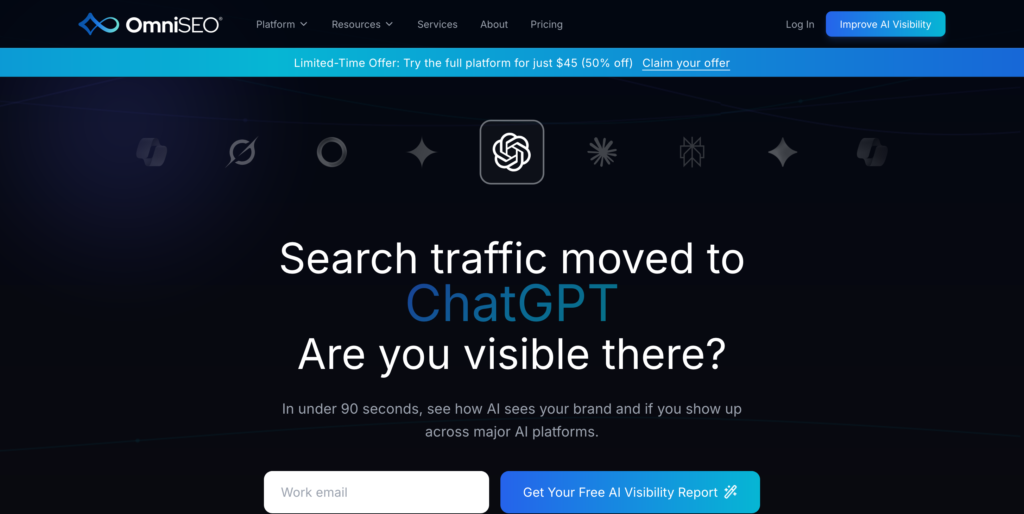
Well, after looking at what it offers, who it seems best suited for, and where it may fall short, the short answer is this: OmniSEO is a promising platform for brands that want to track and improve their visibility not just in traditional search, but across AI-driven discovery channels too. That sounds exciting — and in many ways it is — but it’s not automatically the right fit for everyone.
Some tools are like a Swiss Army knife. Handy, versatile, a bit flashy. Others are more like a sharp chef’s knife: focused, efficient, built for serious work. OmniSEO seems to sit somewhere in the middle. It tries to give marketers a wider lens on search performance, especially in environments where users aren’t simply typing a keyword into Google and clicking the first blue link.
Actually, that’s what makes it interesting. It’s built around a newer problem. A lot of businesses are waking up to the fact that ranking on Google alone no longer tells the whole story. A brand can have solid organic traffic and still be nearly invisible inside AI-generated answers, product comparisons, and conversational search experiences. OmniSEO is designed to address that blind spot.
What OmniSEO Is and Why People Are Looking at It
At its core, OmniSEO is positioned as an AI search visibility and competitive intelligence platform. In plain English, that means it helps businesses understand where and how they show up across modern search experiences, especially those powered by large language models and AI answer engines.
That may sound a bit technical at first, but the idea is fairly simple. Imagine you run a software company, a law firm, an e-commerce store, or even a local service brand. You’re not just trying to “rank” anymore. You want your business to appear when people ask AI systems questions like “What’s the best CRM for small teams?” or “Which SEO platform helps monitor visibility in answer engines?” If your competitors keep getting mentioned and you don’t, that matters. A lot.
That’s the space OmniSEO is trying to own.
Instead of acting only as a classic SEO dashboard, it leans into visibility tracking across AI systems, prompt monitoring, competitor benchmarking, and search intelligence. That makes it feel more aligned with the way discovery works now, especially for brands that depend heavily on being found during the research phase.
And let’s be honest — that research phase has become messy. A customer may start with Google, bounce to Reddit, ask an AI assistant for “best options,” skim reviews, and then return later through branded search. It’s not a straight road anymore. It’s more like a city map with too many side streets. OmniSEO seems built for teams trying to make sense of that sprawl.
First Impressions of OmniSEO
One of the more appealing things about OmniSEO is that the concept feels current. Not forced, not dusty, not stuck in 2018 SEO thinking. There’s a clear attempt to move beyond old-school ranking reports and into something more behavior-aware.
That matters because many SEO tools still feel like they’re reporting from yesterday’s battlefield. You get keyword positions, maybe some backlink data, maybe site audits, and that’s useful — sure — but it doesn’t fully explain how a brand gets surfaced in AI-powered discovery environments. OmniSEO tries to fill that gap.
The platform also appears to focus on monitored prompts, AI channels, competitor visibility, and recommendation layers. That’s a practical direction. Businesses don’t just want data thrown at them in a bucket. They want to know what’s changing, where they’re losing ground, and what to do next.
In that sense, OmniSEO feels less like a vanity-metric tool and more like a decision-support product. At least, that’s the pitch. Whether it fully delivers depends on your needs, your budget, and how advanced your team is.
Key Features of OmniSEO
Let’s talk about what people actually care about: features. Because a fancy homepage means very little if the software doesn’t help you make smarter marketing decisions.
One of the standout ideas behind OmniSEO is AI channel tracking. Instead of only monitoring one search environment, the platform is built to watch how brands appear across multiple AI-driven systems. That’s useful for companies that want to know whether they’re showing up in places like conversational search tools, AI summaries, and emerging answer interfaces.
Then there’s prompt monitoring. This feature is especially relevant now. Rather than focusing only on keywords, OmniSEO lets teams monitor prompts or query patterns that reflect how real users ask questions in AI environments. That’s a subtle but important shift. People don’t always search AI tools the way they search Google. They use longer questions, more context, and more natural phrasing. A platform that acknowledges that difference is already thinking a step ahead.
Competitor tracking is another strong angle. If your rivals are appearing more often in AI-generated answers, that’s strategic intelligence, not trivia. OmniSEO gives teams a way to benchmark that visibility and see where they may be underperforming.
The platform also appears to include placement recommendations. That’s valuable because raw visibility data can feel like reading a weather report without knowing whether to carry an umbrella. Recommendations bridge the gap between reporting and action. They suggest where opportunities exist and where optimization could have the biggest impact.
Some plans also include exports, broader query volumes, more seats, and expanded channel coverage. For agencies or in-house teams that need to share insights across departments, those operational features can matter just as much as the data itself.
There’s also something psychologically reassuring about a tool that centralizes scattered information. Modern search visibility is fragmented. You can check one dashboard for Google data, another for content, another for brand mentions, and something else for competitor intel. That patchwork gets tiring. OmniSEO tries to pull at least part of that into one place, which could save time and reduce blind spots.
How OmniSEO Works in Real Life
Let’s move out of feature language for a minute and make this practical.
Say you run a B2B SaaS company. Your team wants to be recommended when users ask AI tools about the best help desk software for startups. You may already rank decently for some relevant keywords in Google, but when people ask conversational engines for suggestions, your brand barely appears. Meanwhile, two competitors keep getting surfaced.
That’s where a platform like OmniSEO becomes useful. Instead of simply telling you that your organic ranking is stable, it may show that your visibility in AI channels is weak, your competitors are dominating specific prompt clusters, and your presence is inconsistent across answer-driven results.
Or imagine you’re an agency managing multiple brands. One client wants more search visibility, but their traffic report alone doesn’t explain why lead quality has dipped. If OmniSEO can show where the brand is underrepresented in AI-assisted discovery, you suddenly have a more nuanced picture. Not magic. Just better context.
That’s the real appeal here. Not just more numbers, but better interpretation of a changing search ecosystem.
OmniSEO Pricing
Pricing always changes how attractive a tool feels. A platform can be brilliant in theory and still be a bad buy if the cost doesn’t match the value for your business.
From what’s currently presented, OmniSEO offers tiered pricing. The entry plan sits at a relatively accessible monthly rate compared to enterprise-heavy SEO platforms, while the mid-tier and enterprise options move into more serious territory.
The Essentials plan is best understood as a starter package. It gives smaller teams access to core tracking features, a limited number of AI channels, a set volume of saved prompts, a fixed number of competitors tracked, and a modest allowance for ad-hoc queries. For freelancers, startups, or niche site operators who want exposure to AI visibility tracking without spending aggressively, this entry tier may be enough.
The Professional plan is where OmniSEO starts to feel more robust. This level opens access to a larger set of AI channels, higher prompt monitoring limits, broader query volume, more seats, and stronger export capabilities. For growing companies or marketing teams that need recurring data and collaboration, this is probably the most practical tier.
Then there’s the Enterprise option. As expected, that tier is tailored for larger organizations with more complicated requirements. Think custom volume, expanded channel coverage, heavier reporting needs, and a more hands-on relationship. In most cases, that’s not a casual subscription. It’s an operational investment.
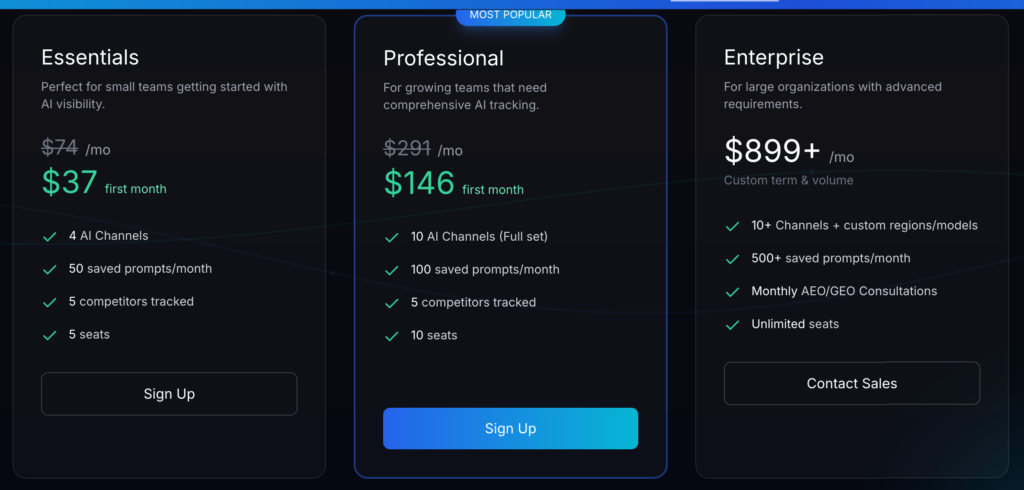
The first-month discount on some plans is a nice touch. It lowers the friction a bit and makes testing less painful. But no, this isn’t exactly a bargain-bin tool. It’s priced more like software for teams that believe AI visibility is becoming a serious business concern, not just a side experiment.
If you’re a solo blogger with a tiny budget, the cost may feel steep. If you’re a marketing lead responsible for pipeline growth and brand discovery across multiple channels, the pricing may feel more reasonable.
That’s the thing with software like this. Value is contextual. A raincoat is overpriced in the desert and essential in a storm.
What I Like About OmniSEO
One big strength of OmniSEO is timing. It’s entering a market where many businesses are finally realizing that SEO is no longer confined to a search engine results page. That alone gives it relevance.
I also like the fact that the platform seems focused on visibility in AI ecosystems rather than pretending the old rules are enough. That doesn’t mean traditional SEO is dead — far from it — but it does mean smart marketers need wider instrumentation. OmniSEO appears to recognize that shift better than many legacy tools.
Another plus is usability. Based on how the platform is positioned and reviewed, it seems to lean toward a relatively approachable interface. That matters more than people admit. A brilliant tool that feels like cockpit software can become shelfware fast. Teams need clarity, not clutter.
The inclusion of competitor tracking, monitored prompts, and actionable recommendations also gives the platform a strategic edge. It’s one thing to know your visibility score. It’s another to know why it changed and where to respond.
And, honestly, consolidation has value. If a platform helps you spend less time stitching together fragments from multiple tools, that’s not just convenience. It’s efficiency, focus, and fewer missed signals.
Where OmniSEO May Fall Short
Now for the less glamorous part.
First, OmniSEO is tied to a relatively new and still-evolving category. That means the metrics themselves may require interpretation. AI visibility is important, yes, but it’s not always as universally standardized or easy to benchmark as classic keyword rankings. Some users may need time to understand what good performance really looks like.
Second, the platform may feel expensive for smaller teams. If your business is still trying to nail basic SEO — technical cleanup, content quality, internal linking, and conversion optimization — then paying for advanced AI visibility tracking might be premature. It’s a bit like buying a drone before learning how to ride a bicycle. Impressive? Sure. Necessary? Not always.
There’s also the issue of feature depth versus feature breadth. A tool that tries to cover a broad search landscape can sometimes feel less specialized in certain classic SEO areas compared to long-established platforms. So if you’re expecting OmniSEO to replace every other SEO solution in your stack overnight, you may want to slow down and evaluate carefully.
Some users may also experience a learning curve, especially if they are new to AI-centric search concepts. Prompt tracking, AI channels, and visibility benchmarking are powerful ideas, but they’re not yet second nature to every marketing team.
And let’s be real: no platform can manufacture authority out of thin air. If your content is weak, your brand footprint is thin, and your site lacks trust signals, OmniSEO won’t wave a wand and fix everything. It’s a tool, not a miracle.
Pros and Cons of OmniSEO
Here’s the balanced version, without turning this into an endless bullet parade.
Pros: OmniSEO addresses a very current marketing problem, it focuses on AI search visibility instead of only conventional rankings, it appears easy to navigate, and it brings competitor monitoring plus prompt-based insights into one environment. For businesses that care about where they appear in answer engines and conversational discovery tools, that’s genuinely useful.
Cons: It may be too expensive for very small businesses, some teams may not fully understand how to use AI visibility data at first, and it may not replace every traditional SEO tool you already use. In other words, it’s powerful within its lane, but you still need a clear strategy around it.
Who Should Use OmniSEO
This is where things get clearer.
If you run a brand that competes in a crowded digital market, especially one where buyers do research across AI tools and comparison-driven journeys, OmniSEO could be a smart investment. It makes particular sense for SaaS companies, agencies, service businesses, and growth-focused marketing teams that want better visibility intelligence.
It may also be useful for organizations that already have traditional SEO in place and want the next layer of competitive insight. If your content engine is functioning, your site is technically healthy, and your team is ready to think beyond Google-only performance, this kind of platform starts to make a lot more sense.
On the other hand, if you’re just launching a site, still struggling to publish consistent content, or haven’t solved basic on-page SEO, OmniSEO may not be your first priority. Fancy analytics won’t compensate for a weak foundation.
That’s not criticism. It’s sequencing. You don’t install stained glass windows before building the walls.
Is OmniSEO Worth It?
Well, yes — for the right user.
If your business depends on discoverability and you believe AI-driven search is already affecting how customers find solutions, OmniSEO looks worthwhile. It seems especially valuable for teams that want to measure presence in newer search environments before competitors run too far ahead.
If, however, you’re looking for a dirt-cheap all-in-one SEO toolkit or you’re still focused entirely on traditional keyword rankings, you may not get the full value from it yet. In that case, it could feel like buying premium hiking boots for a trip to the grocery store.
The strongest case for OmniSEO is not that it replaces everything. It’s that it helps solve a visibility problem many companies can already feel, even if they can’t yet measure it properly.
That distinction matters.
Final Take on OmniSEO
OmniSEO is an intriguing modern SEO platform built around a very real shift in how people search, compare, and discover brands online. It goes beyond old-school ranking reports and leans into AI visibility, prompt tracking, competitor intelligence, and multi-channel search awareness.
That alone makes it more relevant than a lot of outdated SEO software. But relevance doesn’t automatically equal universal fit. For established teams, agencies, and businesses ready to compete in the AI-search era, OmniSEO could be a practical and forward-looking addition to the stack. For smaller operators still mastering the basics, it may be a little too advanced or a little too expensive right now.
Still, the direction is hard to ignore. Search is changing. Buyer journeys are getting more fragmented. Visibility now happens in places that didn’t matter much a few years ago. OmniSEO is built for that reality, and that’s exactly why people are paying attention.
Read Our another Review: Outgrow Review 2026: Interactive Content, Pricing & Features