If your business lives and dies by phone calls, missed opportunities can get expensive fast. A potential customer sees your ad, clicks through, picks up the phone, and calls. The conversation goes well enough, maybe. But then comes the uncomfortable question: Which ad actually brought that lead in? Was it Google Ads? Organic search? A Facebook campaign your team barely remembers launching three weeks ago?
That is exactly the sort of problem CallRail is built to solve.
At its core, CallRail is a call tracking and lead attribution platform designed to help businesses understand where their phone calls, form submissions, texts, and other inbound leads are coming from. But saying only that would undersell it a bit. It’s not just a call log with extra garnish. It has grown into something much broader: a marketing intelligence tool, a conversation analysis platform, and for many businesses, a practical bridge between advertising spend and real-world leads.
And honestly, that’s why so many agencies, law firms, home service companies, healthcare practices, and local businesses keep talking about it. When your customers still prefer to call before they buy, basic analytics can leave a giant blind spot. CallRail tries to fill that gap.
This review takes a close, plain-English look at what CallRail does well, where it falls short, what features you can expect, how pricing generally works, and whether it makes sense for your business. No fluff, no sterile corporate language. Just a practical breakdown.
What Is CallRail, Really?
Well, imagine you run a plumbing company. You’re paying for Google Ads, doing a little SEO, posting occasionally on social media, and maybe even mailing flyers in a few neighborhoods. The phone rings ten times today. Great. But which channel deserves credit?
Without proper tracking, you’re guessing. And marketing based on guesswork usually burns money.
That’s where CallRail steps in. It assigns tracking numbers to different campaigns, channels, or website visitors so you can identify what led to the call. Instead of simply knowing that a call happened, you start to understand why it happened and where it came from.
Think of it like putting tiny, invisible name tags on your marketing channels. Every incoming lead walks in wearing one.
That alone is useful, but CallRail goes further. It also helps businesses track forms, monitor text messages, record calls, transcribe conversations, and use AI-powered insights to flag what matters. So if you’re asking whether it’s just a basic call tracking tool, the short answer is: not anymore.
Who CallRail Is Best For
Not every company needs a platform like this. If you run a purely ecommerce store where almost nobody calls, it may be overkill. But for businesses where phone leads are a big part of the sales process, it can be incredibly useful.
It tends to fit especially well for:
Service businesses like HVAC, roofing, legal services, plumbing, and pest control.
Agencies managing lead generation for multiple clients.
Medical and dental practices where calls often lead to appointments.
Real estate teams that rely on quick contact and local advertising.
Franchise operations needing visibility across locations.
Actually, one of the biggest reasons people choose CallRail is not just tracking. It’s accountability. Agencies want to prove campaign performance. Business owners want to know which half of their marketing budget is being wasted. Sales managers want better visibility into the calls that turn into customers. CallRail sits right in the middle of those needs.
Main Features of CallRail
This is where things get interesting, because feature depth is what separates CallRail from a lot of lighter alternatives.
Call Tracking
This is the flagship feature, and for good reason.
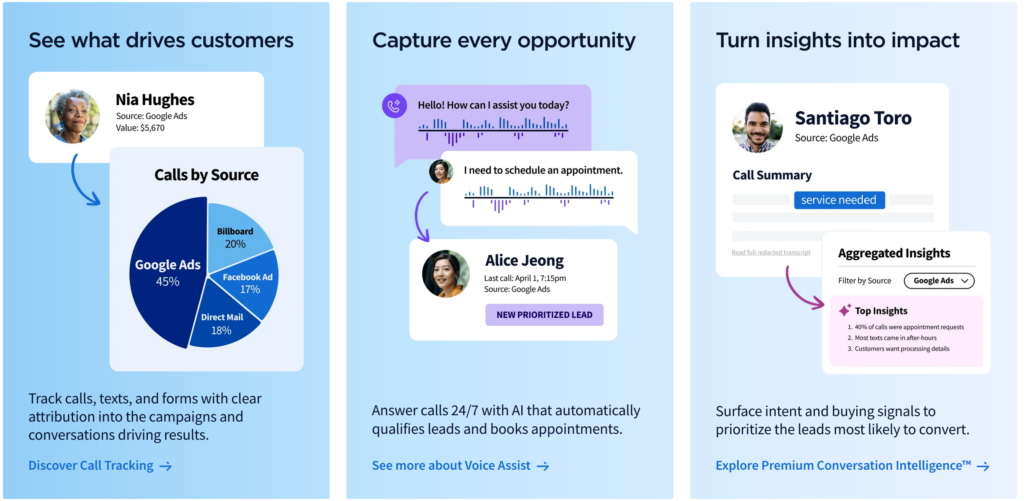
CallRail lets businesses assign unique phone numbers to different campaigns, traffic sources, or sessions. That means when a lead calls, you can trace the source. Maybe it came from an organic blog post. Maybe from a paid search ad targeting emergency repairs. Maybe from a landing page tied to one city.
That level of clarity matters more than it sounds.
Here’s a simple real-world scenario: say you run a family law practice and advertise on both Google Search and a local directory. Both channels claim they perform well. But CallRail may reveal that Google drives more calls, while the directory drives longer, more qualified conversations. That changes how you budget next month.
Dynamic Number Insertion
This feature sounds technical, but the concept is straightforward. CallRail can swap phone numbers on your website based on how a visitor arrived there. Someone from a Google ad might see one number; someone from organic search might see another.
The website still looks the same to users. Behind the scenes, though, attribution becomes much more precise.
It’s a bit like having different reception desks for different campaigns without having to build separate websites.
For businesses spending serious money on paid traffic, this feature alone can justify the platform.
Call Recording
Call recording is one of those tools that sounds optional until you use it. Then it becomes hard to imagine working without it.
With CallRail, businesses can record inbound calls for training, quality control, and lead review. This is especially valuable for teams handling sales inquiries or appointment bookings.
Let’s say your ads are generating plenty of calls, but conversions are disappointing. The issue might not be the ad at all. It might be that staff are answering inconsistently, missing cues, or failing to ask for the appointment. Listening to actual calls helps uncover that.
And yes, sometimes the uncomfortable truth is that the marketing is doing its job better than the front desk.
Call Transcription
Instead of manually listening to every recorded conversation, CallRail can provide transcripts. That saves time, especially for agencies or managers reviewing high call volume.
Transcripts also make it easier to search conversations for recurring questions, objections, service requests, or missed opportunities. If customers repeatedly ask about pricing, financing, availability, or a specific service, that tells you something useful. It’s market research hiding inside everyday phone calls.
Conversation Intelligence
This is where CallRail starts to feel more sophisticated than a standard call tracking app.
Conversation intelligence tools help identify patterns and signals within calls. In plain language, the platform tries to surface what matters: whether the caller sounded like a quality lead, whether certain keywords came up, whether a call likely converted, and so on.
For a busy business owner, that can save an enormous amount of time. You’re no longer skimming a mountain of raw data. You’re getting highlights.
Of course, AI-based features are not magic. They’re helpful, but not infallible. A nuanced sales conversation can still be misunderstood by software. So it’s best to think of these tools as an assistant, not an oracle.
Form Tracking
Phone calls are only part of the picture. A lot of leads prefer filling out a contact form first, especially outside business hours. CallRail can track those submissions too, which means your attribution doesn’t stop at voice calls.
That’s important because modern customer journeys are messy. A person might discover you via SEO, leave, return through a retargeting ad, and submit a form on mobile two days later. If you only track phone calls, you miss half the story.
Text Messaging
Some plans and setups allow businesses to manage text-based communication with leads. That can be handy for appointment confirmations, quick follow-ups, or responding to prospects who would rather text than talk.
And let’s be honest, many people now prefer sending a short message over making a call. For certain industries, text capability can improve response rates and reduce friction.
Integrations
Another reason CallRail has become popular is its integration ecosystem. It can connect with marketing and CRM tools so call and lead data doesn’t stay trapped in one dashboard.
That matters because attribution is most useful when it flows into the systems your team already uses. If a lead source, call outcome, and campaign data can connect to reporting or customer records, decisions become easier. Cleaner data usually leads to cleaner strategy.
User Experience: Is CallRail Easy to Use?
Mostly, yes.
The platform is generally considered approachable, especially compared with enterprise-level analytics software that feels like it was designed by people who enjoy suffering. CallRail tends to present data in a way that marketers and business owners can actually use.
The dashboard is usually where the product earns goodwill. Call logs, source tracking, lead details, and attribution reports are arranged in a reasonably digestible format. You don’t need to be a data scientist to understand what’s happening.
That said, there is still a learning curve. Dynamic number insertion, attribution settings, routing logic, and integrations can be a little fiddly the first time around. If you want deep reporting and clean setup across multiple campaigns, expect to spend some time configuring things properly.
It’s not difficult in the way assembling furniture without instructions is difficult. It’s more like setting up a smart thermostat: doable, valuable, but easier if you pay attention from the start.
CallRail Pricing
Pricing is one of the first things people ask about, and understandably so. CallRail is not usually seen as the cheapest option in the category, but it often lands in that middle ground where businesses feel the value can justify the spend if lead tracking really matters.
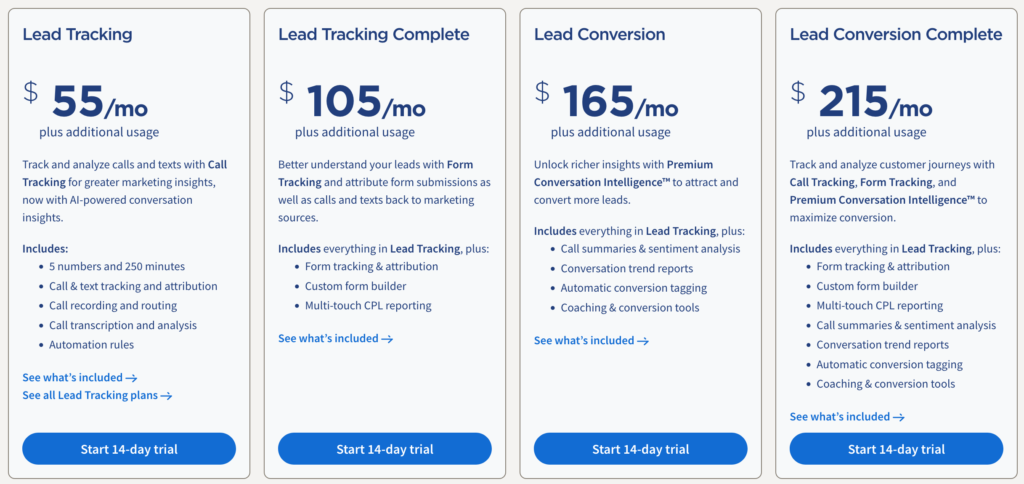
The pricing structure typically depends on the features you need, the number of tracking numbers, and usage volume. Core call tracking is usually the entry point, then additional costs can come in for extras like conversation intelligence, form tracking, and advanced analytics features.
In practical terms, this means a solo business with modest traffic may pay a manageable monthly amount, while an agency or multi-location company with heavy call volume could spend significantly more.
That’s why asking, “How much does CallRail cost?” doesn’t always have one neat answer. The better question is, “How complex is your lead flow, and how much revenue depends on seeing it clearly?”
If one missed attribution insight causes you to keep wasting thousands on the wrong campaign, then even a pricier tool can pay for itself rather quickly.
What You’re Really Paying For
Here’s the more honest version of the pricing discussion: you are not just paying for phone numbers and reports.
You’re paying for visibility.
You’re paying to stop making marketing decisions in the dark.
You’re paying to identify whether your receptionist is handling leads well, whether your agency’s claims hold up, whether your Google Ads campaigns are driving real calls, and whether your landing pages bring in serious buyers or time-wasters.
That’s the pitch, anyway. And for many businesses, it’s a strong one.
Still, value depends heavily on usage. If you log in once a month, ignore recordings, never optimize campaigns, and don’t act on the data, CallRail can become an expensive ornament. A very clever ornament, sure, but still an ornament.
Pros of CallRail
CallRail has a lot going for it, especially for businesses that care about inbound lead attribution. Some strengths stand out more than others.
First, call tracking is where it shines. The platform makes it much easier to connect incoming calls to actual marketing sources, which helps businesses stop relying on hunches.
Second, the reporting is useful without feeling absurdly overcomplicated. You can usually get a clear sense of what campaigns are driving calls and how those calls are being handled.
Third, the conversation tools add practical value. Recordings, transcripts, and AI-assisted insights can help with staff coaching, lead qualification, and campaign refinement.
Fourth, it works well for agencies and multi-channel marketing setups. If you manage several clients or juggle multiple advertising channels, having one place to tie calls and forms back to source is genuinely helpful.
And finally, CallRail often feels like a business tool made for real businesses, not just enterprise teams with huge technical departments. That usability matters.
Cons of CallRail
Now for the less glamorous side.
The first drawback is cost. For small businesses on tight budgets, especially those with low call volume, CallRail may feel expensive once add-ons and advanced features enter the picture.
Second, setup quality matters a lot. If tracking numbers, sources, and integrations are not configured correctly, attribution can get muddy. And muddy data is dangerous because it still looks authoritative.
Third, some features may be more advanced than certain businesses actually need. If all you want is a simple log of incoming calls, the platform may feel like buying a Swiss Army knife when all you needed was a bottle opener.
Fourth, AI and automated insights are helpful but not flawless. They can save time, yes, but they still need human judgment. A transcript or classification model can miss nuance, context, or tone.
So while CallRail is powerful, it is not a plug-it-in-and-forget-it miracle machine.
How CallRail Compares to Simpler Alternatives
Some alternatives focus on bare-bones call tracking. Others lean more heavily into contact center tools or sales communication. CallRail occupies a useful middle space: stronger attribution and marketing visibility than very simple tools, but typically more accessible than large enterprise platforms.
That makes it appealing to growing businesses.
If you’re a local service company spending real money on ads, CallRail often makes more sense than a stripped-down option because the extra attribution detail can directly affect budget decisions.
But if your needs are tiny, a simpler tool may be enough. Not every bakery needs a commercial oven, right? Sometimes a small countertop setup does the job.
Real-Life Use Cases
To make this less abstract, here are a few realistic scenarios where CallRail earns its keep.
A dental clinic runs ads for emergency appointments and cosmetic consultations. With CallRail, they can see which campaigns drive calls, which calls become bookings, and whether front desk staff are handling inquiries properly.
A digital marketing agency uses CallRail to prove ROI to clients. Instead of saying, “Traffic improved,” they can say, “This campaign generated qualified phone leads from these exact sources.”
A roofing company tracks calls after storms hit different regions. They discover paid search drives immediate leads, while SEO content brings in better long-term call quality. That distinction changes how they invest.
A law firm reviews call transcripts and notices potential clients repeatedly asking a question that the website does not answer clearly. They update the site, and lead quality improves.
These are the kinds of practical wins that make a tool like CallRail worthwhile.
Is CallRail Good for SEO and PPC Campaigns?
Yes, especially when phone calls are a core conversion event.
For SEO, CallRail helps reveal which landing pages and organic traffic sources actually generate calls, not just pageviews. That matters because traffic without leads is vanity dressed up as progress.
For PPC, it becomes even more valuable. Paid advertising can get expensive fast, and call attribution helps identify which campaigns, ad groups, or keywords are pulling their weight.
Actually, this is one of the strongest arguments in favor of the platform. Clicks are nice. Calls are often better. And knowing which clicks become calls is where budget decisions start getting smarter.
Is CallRail Worth It?
That depends on how your business gets customers.
If phone calls are central to your sales process, and if you spend meaningful money on marketing, CallRail can be absolutely worth it. It gives you clearer attribution, more useful lead data, and a better understanding of how prospects interact with your business.
If your team will actually review data, listen to calls, improve scripts, and optimize campaigns, the platform can become a revenue tool rather than just a reporting tool.
On the other hand, if calls are rare, budgets are tiny, or nobody on your team plans to use the insights, the return may be limited.
That’s the honest answer. CallRail is not inherently “worth it” for everyone. It’s worth it for businesses that can translate better attribution into better decisions.
Final Verdict on CallRail
So, what’s the bottom line?
CallRail is a strong, well-rounded platform for businesses that want to understand where their leads come from and what happens once prospects make contact. Its call tracking is its anchor, but the broader toolkit — recordings, transcripts, form tracking, messaging, attribution, and conversation insights — is what makes it compelling.
It’s especially useful for agencies and service-based businesses where phone calls are a major source of revenue. The ability to connect marketing activity to actual conversations is not just convenient; it can change the way a business allocates budget and trains staff.
Is it perfect? No. Pricing can climb, setup needs care, and some businesses may not need all the extra horsepower. But when used properly, CallRail can offer something many businesses desperately need and rarely have enough of: clarity.
And in marketing, clarity is expensive to live without.
If your campaigns generate calls and you’re tired of guessing what works, CallRail is definitely worth a serious look.
Read Our another Review: ActiveCampaign Review (2026): Full Test of Automation, CRM & Pricing